
If you've come from the UK, Ireland, the US, Canada, Australia or northern Europe, walking into a Spanish private hospital for the first time can feel surprisingly... nice. Marble lobbies, single rooms with sofa beds, a same-day MRI, a consultant who actually returns your WhatsApp messages. It's a different world from a creaking NHS A&E or a US ER with a $4,000 facility fee waiting at the end.
But Spain's private healthcare system also has its own rules: which networks accept which insurers, when you can walk in versus when you need to book, how direct billing works, and what to expect if you're paying out of pocket. This guide walks you through it the way we wish someone had walked us through it.
What's in this guide
- The Spanish private hospital landscape
- The five major networks (and how they differ)
- Standalone clinics and boutique hospitals
- How you actually access care: walk-in vs appointment
- Direct-bill vs reimbursement insurance
- Private rooms, food and family stays
- English-speaking staff: by region
- Costs without insurance — real prices
- A&E (Urgencias) in private hospitals
- Common pitfalls expats fall into
- How to choose the right insurer for your hospital
- FAQs
1. The Spanish private hospital landscape
Spain has one of the largest private hospital sectors in Europe. Around 457 private hospitals operate across the country, accounting for roughly 57% of all hospital centres and about a third of total hospital beds, according to data from the Fundación IDIS (the Spanish private healthcare association).
What you need to know as an expat is that the sector is split into three tiers:
- National hospital groups — Quirónsalud, HM Hospitales, Vithas, Ribera Salud, Sanitas. These run full-service hospitals with A&E, surgery, ICU, maternity and outpatient clinics. This is where most expats end up.
- Regional and specialist groups — Pascual, HLA, Hospiten (strong in the Canaries and Balearics), IMQ in the Basque Country. Often excellent and sometimes the only private option in smaller cities.
- Standalone clinics and consultancies — Independent specialist clinics for dermatology, fertility, dentistry, physiotherapy. Cheaper for one-off visits but no A&E or inpatient care.
The whole sector is regulated by the Ministerio de Sanidad and by each autonomous community's health authority. That regulation covers licensing, sanitary standards, complaint procedures and the right to a medical history copy — but pricing and customer service are largely unregulated, which is why insurer networks matter so much.
2. The five major networks (and how they differ)
If you're choosing a private insurer in Spain, the question isn't really "which insurance company is best?" — it's "which hospital do I want to use, and which insurer gets me in?". Here's how the big five stack up.
Quirónsalud (Fresenius Helios)
The 800-pound gorilla. Around 50+ hospitals plus dozens of medical centres, owned by German healthcare giant Fresenius Helios. Strong everywhere but particularly dominant in Madrid (Quirón Pozuelo, Madrid, San José), Barcelona (Dexeus, Teknon — see below), Marbella, Málaga, Tenerife and Bilbao. Most expat-friendly insurers accept it. quironsalud.com
HM Hospitales
Around 17 hospitals plus 22 polyclinics, family-owned and quality-focused. Concentrated in Madrid, Galicia (A Coruña, Vigo), Barcelona and León. Often rated as having the best service standards of the big groups. Excellent oncology (CIOCC) and cardiology. hmhospitales.com
Vithas
Around 20 hospitals and 30+ medical centres, strongest along the Mediterranean coast — Alicante, Benidorm, Castellón, Valencia, Málaga, Almería, the Balearics and Canaries. If you're moving to the Costa Blanca or Costa del Sol, Vithas hospitals will probably be your closest option. vithas.es
Ribera Salud
A different beast — Ribera grew out of public-private partnerships (the "Alzira model") and runs both contracted public hospitals and private centres, mainly in the Valencian Community, Madrid and Murcia. Excellent value, modern facilities, slightly thinner expat-services layer than Quirón or HM. riberasalud.com
Hospital Universitario Sanitas (HLA / Sanitas)
Sanitas is unusual — it's both an insurer (owned by Bupa) and operates its own hospitals: Sanitas La Moraleja, Sanitas La Zarzuela and Sanitas Virgen del Mar in Madrid, plus the CIMA clinic in Barcelona. If you're a Sanitas insurance customer, these are your "home" hospitals with the smoothest direct billing.
3. Standalone clinics and boutique hospitals
Outside the big networks, Spain has thousands of independent clinics. Some are world-class — Clínica Universidad de Navarra (CUN) in Pamplona and Madrid, Clínica Rotger in Mallorca, Hospital Ruber Internacional in Madrid (now part of Quirón), Policlínica Gipuzkoa in San Sebastián. Others are small specialist outfits.
Where standalone clinics shine:
- Dentistry — almost always private and very competitively priced
- Fertility (IVF) — Spain is one of Europe's biggest IVF destinations
- Dermatology and cosmetic procedures
- Physiotherapy and sports medicine in tourist areas
- Plastic and reconstructive surgery — Marbella is a hub
The catch: most independent clinics don't have ICUs, A&E or overnight wards. If something goes wrong during a procedure, you get transferred to a network hospital — usually fine, but worth checking the protocol before signing up.
4. How you actually access care: walk-in vs appointment
This is where Spain differs most from systems expats know. There's no GP gatekeeper in the private system — you book directly with the specialist you need.
Booking a specialist
Three normal ways: the insurer's app (Sanitas Mi Salud, Caser Salud y Bienestar, Caser Quiero Cuidarme, Caser app), the hospital's website, or by phone. App bookings are usually the fastest and you can filter by language. Waits for a private specialist appointment are typically 3–10 days, much less for follow-ups.
Walk-in clinics
Most big-network hospitals run a Servicio de Urgencias (24/7 A&E) and an atención sin cita (no-appointment) primary care service during business hours. For minor issues — sore throat, UTI, mild rash, a prescription renewal — you can usually just turn up at a Quirónsalud, HM or Vithas centro médico and be seen within an hour.
Telemedicine
Every major insurer now offers app-based video consultations with a GP, 24/7, in Spanish and English. For travel illnesses, prescription queries and follow-ups, it's faster than driving to the hospital.
5. Direct-bill vs reimbursement insurance
Spanish health insurance comes in two flavours, and the difference matters far more than most policies' glossy brochures suggest.
Cuadro médico (direct-bill, closed network)
You pick a doctor from the insurer's network booklet, the insurer pays the hospital directly, you pay nothing (or a small copay of €3–€15 per visit). This is how 90% of Spanish residents use private healthcare and how all the major insurers — Sanitas, Caser — primarily operate. Pros: zero paperwork, predictable cost. Cons: you're limited to in-network providers.
Reembolso (reimbursement, open network)
You see any doctor anywhere — even abroad — pay upfront, then submit receipts and get a percentage back (typically 80–90%). Caser, Sanitas and Caser all offer premium reembolso tiers. Pros: total freedom of choice. Cons: 2–3x the monthly premium and you front the cash.
Mixed plans
Most expats end up with a hybrid: the standard cuadro médico base, plus a top-up for international reimbursement (useful for trips home) and sometimes a separate dental rider.
| Feature | Cuadro Médico | Reembolso |
|---|---|---|
| Monthly cost (age 40) | €55–€90 | €140–€260 |
| Choose any doctor | No — network only | Yes — anywhere |
| Pay upfront | No | Yes, then reclaim |
| Copays | €0–€15 typical | 10–20% of bill |
| Paperwork | Minimal | Receipts & forms |
| Treatment abroad | Emergency only | Usually covered |
6. Private rooms, food and family stays
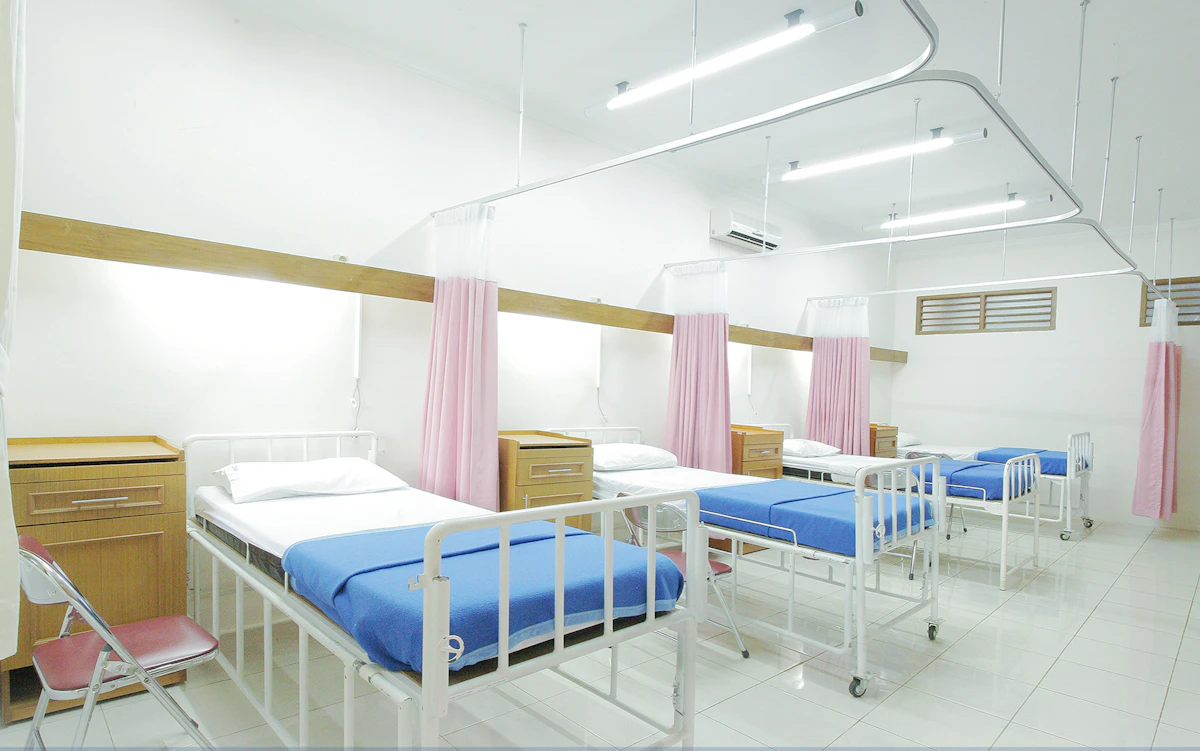
One of the genuine pleasures of Spanish private hospitals: private rooms are standard, not an upgrade. If you're admitted, you'll get an individual room with a sofa bed for a partner or family member to stay overnight, ensuite bathroom, TV, Wi-Fi and a window. Almost universally.
What to expect on the ward:
- Food — usually a choice from a daily menu, often including vegetarian and dietary options. Better than NHS, on par with a mid-range hotel. You can order extras for visitors.
- Family overnights — one accompanying adult is standard; meals for them can be ordered for €8–€12.
- Visiting hours — relaxed compared to the UK, typically 10am to 10pm with no strict limit on numbers.
- Nursing — call buttons get answered. Most wards have one nurse per 5–6 patients on day shift.
Maternity wards are particularly well-equipped — birthing suites, paediatric on call, and a 2-night stay after a vaginal birth or 3–4 nights after a C-section is standard.
7. English-speaking staff: by region
This is the question we get asked most. The honest answer: it varies enormously by region and by department. As a rule, the more international the area, the more English you'll find — and senior consultants almost always speak more English than ward staff.
| Region | English availability | Best hospitals for expats |
|---|---|---|
| Costa del Sol (Málaga, Marbella) | Excellent — bilingual reception, English-speaking GPs on staff | Quirónsalud Marbella, Vithas Xanit, HC Marbella |
| Costa Blanca (Alicante, Benidorm) | Excellent — large UK community | Vithas Medimar, HCB Benidorm, Quirón Torrevieja |
| Balearics (Mallorca, Ibiza) | Very good — German and English widely spoken | Clínica Rotger, Quirónsalud Palmaplanas, Juaneda |
| Canary Islands | Good — strong in tourist hubs | Hospiten, Quirónsalud Costa Adeje, Vithas Las Palmas |
| Madrid | Good in flagship hospitals, variable in suburbs | Ruber Internacional, HM Montepríncipe, Sanitas La Moraleja |
| Barcelona | Good — international city | Teknon, Dexeus, Hospital de Barcelona |
| Valencia city | Moderate — improving | Vithas 9 de Octubre, IMED Valencia |
| Bilbao / San Sebastián | Moderate — Spanish strongly preferred | Quirónsalud Bilbao, Policlínica Gipuzkoa |
| Inland (Granada, Sevilla, Zaragoza, Galicia) | Limited outside private flagships — bring a translator app | HM Rosaleda, Vithas Granada |
8. Costs without insurance — real prices
If you don't have insurance, Spanish private healthcare is still significantly cheaper than the US or UK private equivalents — but it's not free. Here are realistic 2026 rates from the major networks. Expect 10–20% lower at regional clinics, 20–40% higher at premium centres like Ruber Internacional or Teknon.
| Service | Typical price (€) |
|---|---|
| GP consultation | €60 – €120 |
| Specialist consultation (cardiology, dermatology etc) | €80 – €180 |
| A&E visit (Urgencias) — minor | €150 – €350 |
| Blood test panel (basic) | €40 – €90 |
| X-ray | €50 – €120 |
| MRI (single region) | €280 – €550 |
| CT scan | €220 – €450 |
| Ultrasound | €80 – €160 |
| Endoscopy / colonoscopy (incl. sedation) | €450 – €900 |
| Day-case surgery (e.g. cataract per eye) | €1,800 – €3,500 |
| Knee arthroscopy | €3,500 – €6,000 |
| Hip replacement (total) | €10,000 – €18,000 |
| Vaginal birth (uncomplicated) | €4,500 – €7,500 |
| C-section | €6,500 – €10,500 |
| One night in a private room (no surgery) | €450 – €750 |
| ICU per day | €1,800 – €3,200 |
9. A&E (Urgencias) in private hospitals
Private hospital A&E departments — Urgencias — work very differently from public ones. They're open 24/7, but the volumes are far lower. Typical wait times at a Quirón or HM urgencias on a weekday evening: 10–30 minutes to be triaged, often seen straight after.
You can walk into any private hospital's A&E without an appointment. If you have insurance and the hospital is in your network, swipe your insurer's app or card and you're processed in seconds. If not, you'll be asked for a credit card or cash deposit — typically €200–€500 — before being seen for non-life-threatening complaints. Life-threatening cases are always treated first, payment sorted afterwards.
10. Common pitfalls expats fall into
Assuming "private" means "no waiting list" for everything
For routine consultations, scans and most surgeries — yes, you'll be seen within days. But for certain specialists (some oncologists, top fertility consultants, paediatric subspecialists) the best individual doctors still book out 4–8 weeks ahead. Insurance gets you the right to a network doctor — not necessarily the doctor.
Forgetting about co-payments
Many Spanish insurers offer copay plans (you pay €3–€15 per appointment) at a discount of 30–40% off the premium. Looks like a great deal — until you realise a family of four with five appointments a month each runs through €600+ a year in copays. Do the maths for your family.
Mixing up network tiers
"Sanitas Más Salud" gets you into one network. "Sanitas Premium" gets you into a bigger one including Sanitas's flagship hospitals. The same is true of Caser Plena vs Caser Completa, Caser Top vs Mundo. Read which hospitals are actually in your tier — not just which insurer.
Not declaring pre-existing conditions
Spanish insurers don't always ask exhaustive medical questions when you sign up, but if you claim for something they later prove was pre-existing and undeclared, they'll refuse the claim and may cancel the policy. Disclose. Always.
Waiting until they need it to compare quotes
Most Spanish private policies have waiting periods: 6–8 months for surgery and birth, 10 months for major dental work. Sign up when you're healthy, not when you're already worried about something.
11. How to choose the right insurer for your hospital
The simplest decision framework we know:
- Identify your nearest 2–3 hospitals you'd actually want to use. Google "[your town] private hospital" and check the network.
- Confirm which insurers have those hospitals in their network — every insurer publishes a cuadro médico online by postcode.
- Check the English-speaking doctor list for the specialties that matter to you (GP, gynaecology, paediatrics if you have kids).
- Compare quotes for the same level of cover — not just headline premium. Look for: hospitalisation cover, A&E without copay, maternity if relevant, dental rider, international cover.
- Read the small print on waiting periods and exclusions before signing.
Quirónsalud is accepted by Sanitas, Caser and many others. HM Hospitales is accepted by most major insurers including Caser and Allianz. Vithas has wide acceptance. Sanitas hospitals are typically Sanitas-only. Ribera Salud has its own insurance arm but is also accepted by some independents.
Need help comparing health insurance in Spain?
We work with all the major insurers — Sanitas, Caser and more. A 10-minute call gets you a side-by-side comparison with the hospitals you care about already filtered in.
Get a Health Insurance Quote12. Frequently asked questions
- Can I use a private hospital if I'm on the Spanish public system (SNS)?
- Yes. The two systems are completely separate — being registered with the public system doesn't stop you using private hospitals. Many Spanish residents use the public system for chronic conditions and major emergencies, and private for everything routine.
- Do private hospitals in Spain accept UK GHIC or EU EHIC cards?
- No. Those cards only work in public healthcare facilities. In private hospitals, you'll need Spanish private insurance, a travel insurance policy that covers you, or you pay out of pocket.
- How do I get a referral to a specialist in the private system?
- You usually don't need one. Pick the specialist directly from your insurer's network app and book. If they need scans or tests first, they'll order them — but there's no GP gatekeeping the way there is in the UK or Ireland.
- What's the difference between a hospital and a clínica?
- In Spain the words are used loosely. A clínica is sometimes a smaller, often older private hospital (think Clínica Rotger, Clínica Universidad de Navarra) and sometimes a single-specialty outpatient clinic. The size, services and quality vary — always check facilities, not just the name.
- Can I have a baby in a private hospital in Spain as an expat?
- Yes, and many expats do. Private maternity wards have private rooms, English-speaking obstetricians in most flagship hospitals, and shorter stays than public. Costs run €4,500–€10,500 out of pocket depending on the type of birth; insurance covers it with a 6–10 month waiting period.
- What happens if I need treatment in a hospital that's not in my network?
- For genuine emergencies you'll be treated and your insurer will usually reimburse you (keep all paperwork). For non-emergencies, you pay out of pocket or transfer to a network hospital once stable. Reimbursement (reembolso) policies remove this restriction entirely.
- Are prescriptions covered by private hospital insurance?
- Generally no — Spanish private health policies cover consultations, scans, hospitalisation and surgery, but not prescription medications outside of hospital stays. Pharmacies (farmacias) are inexpensive in Spain compared to the US or UK private rates, so this is less of an issue than it sounds.
- Which private insurer is best for expats overall?
- It depends entirely on where you live and which hospital is closest. As a broad starting point: Sanitas for Madrid and Barcelona and customers who value strong English support; Caser for the largest network and best coastal coverage; Caser for excellent international tier and reimbursement options; Caser for value-conscious buyers. We'd rather compare your specific situation than guess.
This guide is general information only and does not constitute insurance, medical or financial advice. Pricing, network composition and policy terms change frequently — always verify current details with the insurer or hospital before relying on them. 247 Expat Insurance is an introducer of regulated UK and Spanish insurance products.